
Why this question matters more than you think
If you’ve searched for:
- “Which magnesium is best for sleep?”
- “Magnesium glycinate vs oxide which is better?”
- “Why is my magnesium supplement not working?”
You’re not alone.
Magnesium deficiency is increasingly common due to:
- Processed diets
- Stress-driven lifestyles
- Poor soil mineral content
But here’s the real issue:
Most people are taking the wrong form of magnesium — and that’s why they don’t see results.
What does magnesium actually do in your body?
Magnesium supports:
- Nervous system regulation (calm vs stress response)
- Muscle relaxation
- Sleep quality
- Blood pressure balance
- Energy production (ATP)
Common symptoms people search for:
- “Why am I tired even after sleep?”
- “Why do I feel anxious for no reason?”
- “Why do I get muscle cramps at night?”
These are often linked to low magnesium levels.
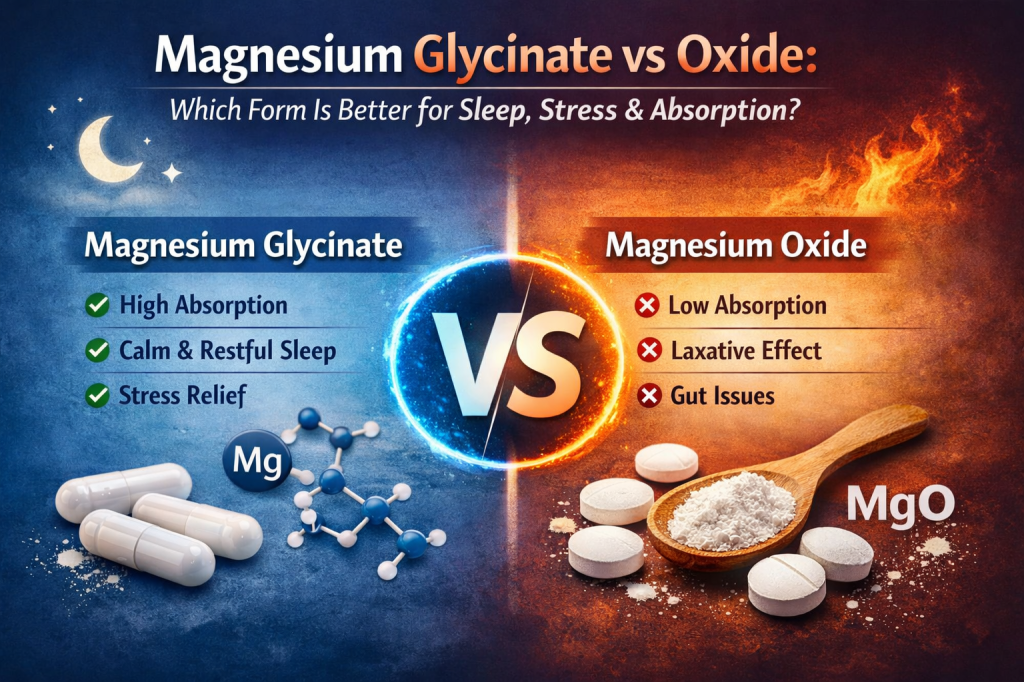
What is Magnesium Oxide?
Magnesium oxide is an inorganic form of magnesium, widely used in low-cost supplements.
Why is it commonly used?
- Cheap to produce
- High elemental magnesium on label
The reality:
- Very low absorption (around 4–10%)
- Most of it stays in the digestive tract
What does it actually do?
- Acts as a laxative
- Helps relieve constipation
Common user complaints:
- “Magnesium gives me loose motions”
- “I didn’t feel any benefit”
This is usually due to magnesium oxide.
What is Magnesium Glycinate?
Magnesium glycinate is a chelated form, where magnesium is bound to glycine (an amino acid).
Why this matters:
- Highly absorbable
- Gentle on the stomach
- Supports nervous system function
What people search for:
- “Best magnesium for anxiety and stress”
- “Magnesium for sleep which is best?”
Magnesium glycinate is often the preferred answer.
Why it works:
- Glycine promotes relaxation
- Supports deeper sleep
- Helps calm the nervous system
Magnesium Oxide vs Glycinate: Key Differences
| Feature | Magnesium Oxide | Magnesium Glycinate |
|---|---|---|
| Absorption | Very low | High |
| Purpose | Laxative | Therapeutic |
| Sleep support | No | Yes |
| Anxiety support | No | Yes |
| Gut effect | Can cause diarrhea | Gentle |
| Long-term use | Not ideal | Ideal |
Most Asked Questions (Answered Clearly)
Which magnesium is best for sleep?
Magnesium glycinate — supports relaxation and deeper sleep.
Can magnesium reduce anxiety and stress?
Yes, especially glycinate — helps regulate neurotransmitters.
Why does magnesium upset my stomach?
Likely magnesium oxide. Switch to glycinate.
Which magnesium is best for blood pressure?
Magnesium glycinate — supports vascular relaxation.
Magnesium glycinate vs citrate vs oxide?
- Glycinate → best for sleep, stress, long-term use
- Citrate → moderate absorption, mild laxative
- Oxide → mainly laxative
Why most supplements fail (Hidden truth)
Many brands:
- Use magnesium oxide to cut costs
- Highlight “high mg” on labels
- Deliver poor real-world results
Absorption matters more than numbers.
What should you actually choose?
If your goal is:
- Better sleep
- Reduced anxiety
- Muscle recovery
- Blood pressure balance
Choose magnesium glycinate.
Who should consider magnesium glycinate?
You may benefit if you:
- Feel mentally overstimulated
- Have poor sleep quality
- Experience frequent stress
- Get muscle cramps
- Have lifestyle-related BP fluctuations
Dosage & timing
When to take magnesium glycinate?
Night (supports relaxation and sleep)
How much per day?
Typically 200–400 mg elemental magnesium
Safety & concerns
Magnesium glycinate is generally safe.
Possible mild effects:
- Slight drowsiness (useful at night)
Consult a doctor if:
- You have kidney issues
- You are on medication
The Ko-sha Perspective
At Ko-sha, we believe:
Purity is not just about ingredients — it’s about effectiveness.
A supplement should:
- Be in a form your body can absorb
- Deliver measurable benefits
- Support long-term health
Final Insight
When choosing magnesium, don’t ask:
“How much magnesium is in this?”
Ask instead:
“How much will my body actually absorb?”
Bottom Line
- Magnesium oxide → low absorption, mainly for constipation
- Magnesium glycinate → high absorption, supports sleep, stress & recovery
A smarter way to supplement
If magnesium didn’t work for you before…
It wasn’t magnesium — it was the form.


 Ko-sha
Leave a comment